

Read the NFP building blocks series:
#1 How Nonprofits Can Improve Financial Reporting with Sage Intacct Dimensions
#2 Better Visibility for Nonprofits With Sage Intacct Dashboards
Real-time visibility from Dimensions and Dashboards gives nonprofit leaders more useful financial information. But access to data is only part of the equation. That information must also be accurate, well-documented and able to withstand external scrutiny.
Compliance goes beyond meeting regulatory requirements. It helps nonprofits demonstrate responsible stewardship, maintain funder confidence and protect the resources that support their mission.
The Challenge of Staying Audit-Ready
Nonprofit finance teams manage a range of reporting, documentation and compliance responsibilities. Depending on the organization and its funding, those responsibilities may include:
- Tracking grant budgets against actual results
- Separating donor-restricted and unrestricted activity
- Preparing financial reports consistent with applicable accounting standards
- Supporting Form 990 preparation
- Monitoring grant-specific requirements
- Providing transaction support during an annual audit
Managing these responsibilities through spreadsheets and other manual processes can be time-consuming and error-prone. It can also create a stressful rush before the annual audit as the finance team gathers invoices, approvals and supporting documentation from multiple sources.
Building Compliance into Daily Workflows with Sage Intacct
Compliance is more manageable when it is part of the organization’s regular processes rather than a separate exercise performed before an audit. Sage Intacct can support this approach by bringing grant data, transaction details, approvals and reports into a connected environment.
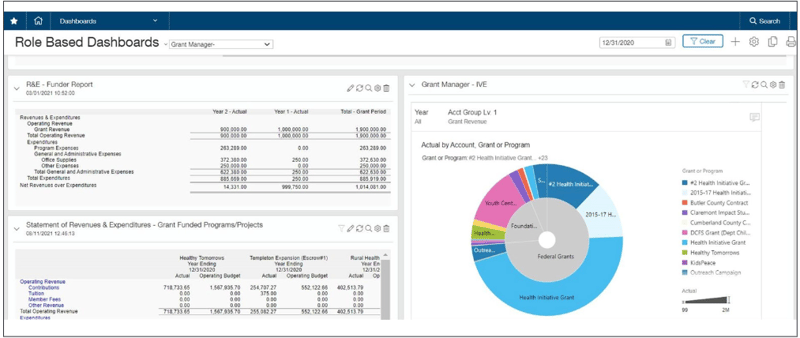
Key capabilities include:
Real-Time Grant Tracking
Budget-to-actual reports can help finance and program leaders monitor spending by grant. This provides a current view of how much has been spent and what remains available, assuming transactions are entered accurately and on time.
Restricted and Unrestricted Reporting
Dimensions can help classify and report donor-restricted and unrestricted activity without creating a separate general ledger account for every possible combination. This gives leadership a clearer view of how resources may be used.
Drill-Down Audit Trails
Authorized users can move from summary reports to supporting transaction details. This makes it easier to investigate balances, answer questions and retrieve available documentation.
Role-Based Auditor Access
Role-based security may allow organizations to give external auditors read-only access to selected reports, dashboards and transaction details. Carefully configured access can make information easier to review without providing unnecessary system permissions.
Auditors may still request additional documentation or explanations, but centralized access can reduce repeated requests and the time finance teams spend locating support.
Scheduled Reporting
Recurring reports can be scheduled to help finance teams monitor grants and identify issues throughout the year. Note that while automation improves access to information, it does not replace professional judgment or internal controls.
The Benefit of Grant Tracking & Compliance with Sage Intacct
In a manual environment, audit preparation can become a seasonal scramble. The finance team spends weeks locating documents, reconciling spreadsheets and explaining transactions recorded months earlier.
A connected system can support a more continuous approach. When transactions are consistently classified, approved and documented as part of the normal workflow, the organization does not have to recreate the full record at year-end.
A more structured approach to compliance and grant tracking can benefit the entire organization:
- More efficient audit preparation: Centralized transaction details and documentation can reduce the time spent gathering support.
- Lower risk of manual error: Consistent classifications and workflows can reduce reliance on disconnected spreadsheets.
- More secure collaboration: Role-based access can give auditors and internal stakeholders relevant information while protecting sensitive data.
- Clearer donor reporting: Detailed reports can help demonstrate how funds were used and how they supported the mission.
- Stronger governance: Timely, supportable information gives executives and board members a better foundation for oversight and decision-making.
Compliance should not depend on a last-minute search for documents. When grant tracking is integrated into daily workflows, finance teams can spend less time reconstructing the past and more time helping the organization plan ahead.
Once compliance and grant tracking are under control, the next opportunity is to simplify everyday financial processes. In our next post, we’ll explore how nonprofits can streamline workflows and improve operational efficiency.

