

There is often a need for end-users to run SQL Jobs on an ad-hoc basis. This creates a security issue because we don't want to install SQL Server Management Studio on the end-user workstation and we don't want to give out Remote Desktop access to the SQL Server or grant additional security within SQL.
Here is a quick process that solves these issues and allows an end-user to run a SQL Server Agent Job from a Windows BAT file on their workstation:
- Create the job in SQL Server so it exists and runs successfully from the server.
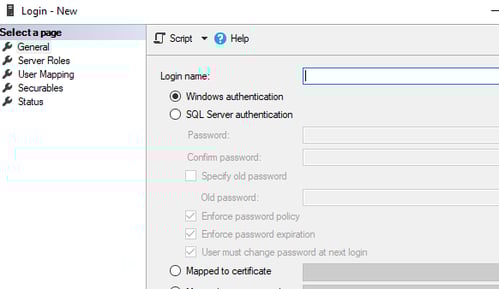
- Create a new SQL Server login for the end-user's windows authenticated account within the SQL Server security node
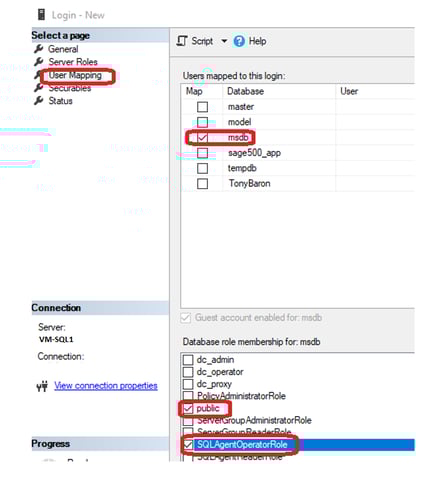
- In the User Mapping page, grant the user SQLAgentOperatorRole for MSDB. This will allow the user to start a SQL Agent job without giving them unneeded permissions in SQL.
On the User’s machine:
- Manually create a path in Windows Explorer on the user's workstation, example: C:\SQLBATCH
- Copy OSQL.exe file from a machine with an installation of SQL Tools (should be in the same or similar directory) to the user's workstation
- Next, create a windows batch file on the user's workstation as follows:
- Create a New Text document and rename the extension from TXT to BAT on the user's desktop
- Right-click the new BAT document and choose Edit
- Enter the following text in the new BAT document replacing [SQL SERVER NAME] and [SQL JOB NAME] with your actual names
ECHO Executing job
ECHO.
CD C:\SQLBATCH
sqlcmd -S "[SQL SERVER NAME]" -E -Q"exec msdb.dbo.sp_start_job '[SQL JOB NAME]'"
ECHO Job execution completed
pause
CLS
EXIT
- Save the BAT file and double-click it to execute it
NOTE: the BAT file will return a successful message indicating the job was started. It doesn't tell you if the job had errors. An administrator on SQL still needs to monitor the jobs for errors.
Working example:
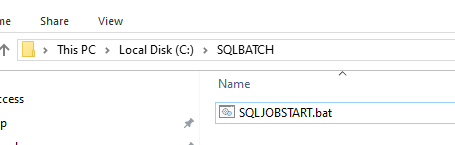
Create a folder named SQLBATCH on the user’s machine. Then create a file named SQLJOBSTART.bat
Enter the following, replacing names where necessary. Then save the file :
ECHO Executing job
ECHO.
sqlcmd -S "VM-SQL1" -Q "exec msdb.dbo.sp_start_job 'Sage 500 ERP sage500_app QtyOn'"
ECHO Job execution completed
pause
CLS
EXIT
The above shows an example of a batch file that will execute the Sage 500 QtyOn job on machine named VM-SQL1. For details about the switches used by the sqlcmd, type sqlcmd /? from a command window. The results from the execution run appear below.
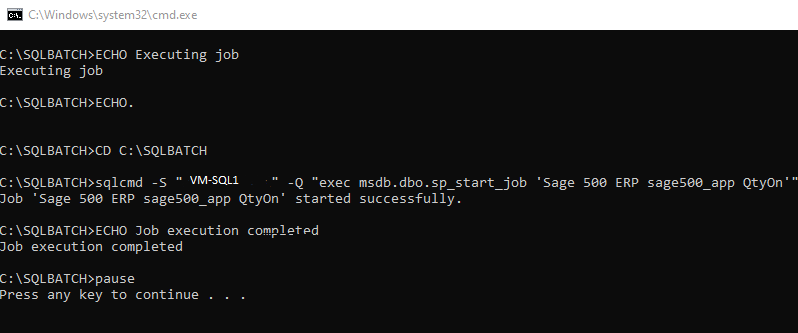
NOTE: the BAT file will return a successful message indicating the job was started. It doesn't tell you if the job had errors. An administrator on SQL still needs to monitor the jobs for errors.