

In recent conversations, a clear sentiment has emerged. Growth remains stable, but caution is guiding decision-making. Construction leaders are pressing pause, reexamining project pipelines, and scrutinizing cash flow more closely than in prior years. Throughout these discussions, current market conditions consistently take center stage, as firms balance ongoing project demand with concerns around interest rates, material volatility, and labor availability. At the same time, rapid technological advancements are reshaping expectations—both in the field and in the back office—pushing construction organizations to rethink how they plan, execute, and measure performance across every project.
According to the Associated Builders and Contractors of America (ABC), the Association of General Contractors of America (AGC), and the Engineering News-Record (ENR), the construction industry is facing more challenges than last year, yet there are areas for optimism. Expectations for hiring and overall outlook remain dampened, largely due to ongoing recession risks. Many firms are reassessing staffing needs while keeping a close eye on economic developments.
Material Costs and tariff uncertainty
Material costs remain a critical concern, with 53% of respondents ranking it among the top five, along with tariff and trade uncertainties. While some tariffs are already in place, the interpretations of those exemptions can be very vague, with unclear percentage changes.
Uncertainty around tariffs and trade policy further clouds long-term planning, and tighter financing conditions, with some organizations raising bid prices, passing most or all of the tariff costs onto the project owner, or accelerating project purchases. Although prices are still well above pre-pandemic levels, signs of stabilization are giving the industry cautious optimism, offering some relief for project planning, though uncertainty remains for long-term budgeting and forecasting.

Supply and Demand shifts
Overall demand is shifting, driven by at least one trend: the possibility of a recession. The construction of data centers, power generation, and healthcare projects is central for growth, while the commercial sector, including retail and private construction, is seeing softening demand.
Regional trends reveal a common landscape within the industry:
- Northeast: Power, data centers, and transportation projects are expected to grow in the Northeast, while the education and retail sectors are reporting significant downturns of 17% compared to 2025.
- Midwest: Within the Midwest, growth is primarily driven by investments in data centers, power infrastructure, and healthcare facilities. Conversely. Retail and higher education construction saw the sharpest declines.
- West: Similar to the other regions, data centers, power, and healthcare projects are leading in the West. However, private office construction and retail are areas of pronounced contraction, with a 24% downturn.
These trends highlight the importance of staying informed and adjusting strategies accordingly. The rapid adoption of AI and cloud-based services, along with rising energy demands for data centers, appear to be the main drivers of this growth. While some sectors and regions are performing well, others continue to face headwinds such as supply chain disruptions and tariffs, underscoring the importance of careful planning.
Economic Factors
Project financing remains a significant challenge for the industry. Over 63% of survey respondents reported that a project was postponed, scaled back, or canceled within the past six months. Securing funds for large-scale projects often requires complex financial arrangements and extensive reporting, which adds to the organization's administrative burden. Almost 37% said reduced funding or funding uncertainty contributed to the postponement, scaling back, or cancellation of projects.
It may not be a major concern among construction professionals, but insurance also plays a critical role in project financing. Effective risk transfer is essential for protecting assets, mitigating potential losses, and meeting lender requirements.
Ongoing Changes in the Labor Market
Labor availability remains a top concern for construction leaders, which puts pressure on schedules and budgets. Persistent labor shortages—especially in skilled trades—are forcing many firms to compete more aggressively for talent.
The ABC projects that the construction industry will need to add roughly 349,000 new workers in 2026 just to keep up with the demand. If not addressed, existing shortages are likely to intensify, particularly in growing sectors like data centers and power infrastructure, driving wages higher and further pressuring project economics. They also estimate that the majority of new labor demand in 2026 will stem from 20% of U.S. workers approaching retirement and from an aging workforce, rather than new construction activity.
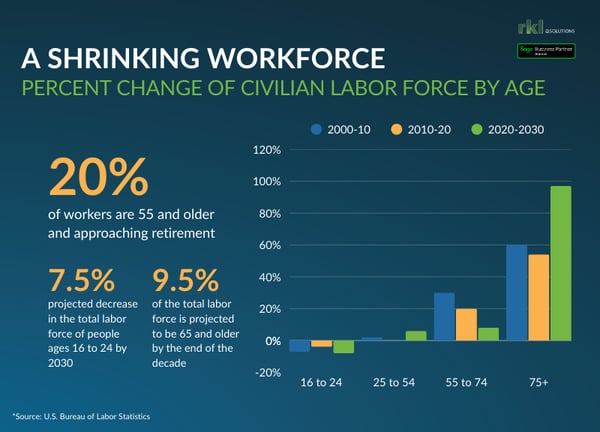 Beyond retirement, multiple structural forces are converging: an aging workforce, declining interest from younger generations, limited trade training programs, stricter immigration policies, higher material costs, tariff uncertainty, and rapid technological shifts. Together, these factors support the industry’s goal of attracting, developing, and retaining talent at every level.
using technology to address concerns
As any builder knows, a strong foundation is essential, and for construction finance professionals, that means using cloud-based enterprise resource planning (ERP) software. Sage software, the number one provider of accounting and estimating solutions in the industry, not only manages transactions and tracks WIP and change order reports, but also has a built-in AI assistant, allowing firms to respond quickly and confidently to project and market changes.
As technology continues to advance, smaller companies can now plan and allocate their limited resources more strategically—sometimes even surpassing larger competitors. With the right systems in place, businesses can leverage historical data alongside forward-looking analytics to quickly evaluate multiple options and choose the optimal path forward. Faster, more confident decision-making requires close alignment between planning and execution, which is essential to remaining competitive in the market.
It's no surprise that businesses are turning to automation and AI assistants to navigate today’s dynamic environment. About 45% of firms use AI for office and administrative functions, 23% for estimating, 20% for design or preconstruction, and 16% for recruitment, training, or other HR functions. Automating routine and repetitive tasks transforms the accounting process from manual data entry, which is often error-prone, into a streamlined review approach.
Key Takeaways
- Policy uncertainty: Unclear tariff policies present significant risks. Buying materials earlier at a lower cost or considering the use of other materials is recommended.
- Labor constraints: Labor availability remains a key concern. Adopting the use of cloud-based technology to reduce manual, repetitive work helps retain talent.
- Budgeting and forecasting: Accurate budgeting and cost control are paramount for success.
We’re seeing businesses increasingly reach out to trusted advisors to help improve operations, gain deeper insights and accelerate growth with cutting-edge technology. They assist clients in better managing finances, accounting processes and personnel. Our clients are increasingly leveraging technology to drive progress, whether through automating equipment, deploying drones, or upgrading their ERP systems. As we look ahead to 2026, technology will continue to play a central role in supporting teams and ensuring continued business success.
This information was sourced from insights gathered during the ENR's 2026 Construction Forecast, the AGC's 2026 Construction Hiring and Business Outlook Survey, and the ABC's 2026 Construction Spending and Employment Forecast, focusing on the construction industry outlook for 2026. The events provided comprehensive overviews of the challenges and opportunities in the construction industry, including the impacts of tariffs, labor market shifts, and economic headwinds.